Sonia had spent years saying that she wanted a successful fitness business.
She wanted full classes.
She wanted a waiting list.
She wanted to earn good money doing work she genuinely loved.
She wanted to stop worrying every month about whether enough money was going to come in.
And slowly, after years of hard work, things started to happen.
Her classes were filling.
Her clients were recommending her.
People were enquiring about working with her.
Her income was becoming more consistent.
From the outside, Sonia was doing brilliantly.
But then something strange started to happen.
The brakes went on.Sonia stopped posting as regularly on social media.
She had always been quite consistent, but suddenly every post needed to be perfect.
She would write something, delete it, rewrite it and then decide not to post it at all.
She started questioning her prices.
Even though clients were happily paying them and getting excellent results, she worried that she was charging too much.
She began offering discounts that nobody had asked for.
A local business invited her to collaborate on an event that could have introduced her to lots of potential new clients.
She was initially excited.
Then she started thinking…
What if nobody comes?
What if loads of people come?
What if people expect more from me afterwards?
What if I’m not ready?
She told herself that she was “too busy at the moment” and turned it down.
Then Sonia had an idea for a new small group programme.
Her current clients loved the idea.
Several people told her they wanted to join.
So Sonia created the outline.
Then changed it.
Then added more to it.
Then changed the name.
Then decided she needed new branding.
Then thought she should redo her website first.
Three months later, the programme still didn’t exist.
Sonia told herself she needed to be more disciplined.
She told herself she needed to stop being lazy.
She told herself she obviously didn’t want success badly enough.
But none of those things were true.
Sonia was working incredibly hard.
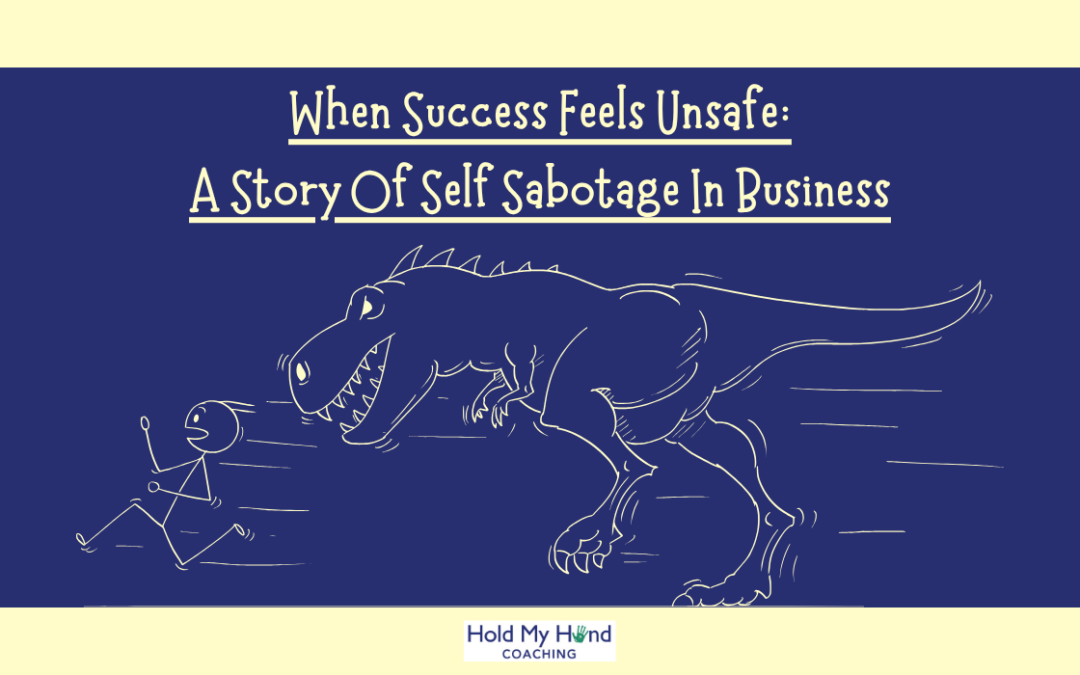
The problem was that a part of her was scared of what might happen if the business really did become successful.
When we think about self sabotage, we often imagine someone knowingly destroying something good.
But that is rarely what happens.
Sonia didn’t wake up in the morning and think:
“How can I damage my business today?”
She genuinely believed she was making sensible decisions.
She thought she needed to improve her programme before launching it.
She thought she needed to be careful about her prices.
She thought she was being realistic about the collaboration.
She thought her marketing needed to be better before she shared it.
But underneath all of those apparently sensible thoughts was fear.
Success meant being more visible.
Success meant people having expectations of her.
Success meant holding more responsibility.
Success meant moving away from the version of herself and her business that, while sometimes frustrating, was familiar.
And familiar can feel safer than better.
We often talk about fear of failure, but fear of success can be equally powerful.
Because success brings change.
And change, even positive change, can create uncertainty.
You might wonder:
Will I be able to cope?
What if I become too busy?
What if people expect more from me?
What if I can’t maintain it?
What will people think of me?
What if I outgrow people or places that currently feel safe?
What if I finally get what I want and it doesn’t make me feel how I expected?
These thoughts are not always conscious.
That is why self sabotage can be so confusing.
On one level you are saying:
“I want more clients.”
While another part of you is avoiding following up enquiries.
You are saying:
“I want to earn more money.”
While another part of you keeps discounting your services.
You are saying:
“I want to be known for what I do.”
While another part of you is hiding, endlessly editing content or waiting until you feel more confident.
This is not because you are broken.
It is not because you are incapable of success.
And it is not because you secretly want your business to fail.
Often, a part of you is simply trying to keep you safe.
The problem is that its version of safety may be based on staying where you are.
Sonia’s turning point wasn’t another business strategy.
It wasn’t a new planner.
It wasn’t a more complicated marketing plan.
It started with one question:
“What are you afraid might happen if this actually works?”
Her immediate answer was:
“Nothing. I want it to work.”
But she stayed curious.
I asked more questions.
And eventually, some other answers appeared.
If the business grew, she was worried she would lose her freedom.
She was worried she would become overwhelmed.
She was worried clients would expect her to always have the answers.
She was worried that more success would mean more pressure.
And, deep down, she wasn’t completely sure she was the kind of person who could run a genuinely successful business.
Those fears had been quietly influencing her decisions.
Once she could see them, she could start working with them.
Instead of pulling back from marketing, she created a level of visibility she could sustain.
Instead of discounting her prices because she felt uncomfortable, she learned to sit with the discomfort of charging appropriately.
Instead of turning down opportunities immediately, she gave herself time to understand whether she genuinely wanted to say no or whether fear was making the decision.
And instead of trying to create the perfect programme, she launched a simple first version.
Nothing magical happened overnight.
She still had moments of doubt.
She still overthought things sometimes.
But she became much quicker at noticing when a part of her was reaching for the brakes.
And that awareness changed everything.
It can be easy to believe that the thing standing between you and the success you want is another strategy.
Sometimes it is.
But sometimes you already know what to do.
You know you need to send the email.
Make the offer.
Follow up the enquiry.
Talk about your service.
Raise the price.
Finish the programme.
Ask for help.
Say yes to the opportunity.
Or perhaps say no to something that is keeping you busy but stopping you from growing.
The useful question is not:
“What is wrong with me?”
The useful question is:
“What might a part of me be trying to protect me from?”
Then get curious.
What does that part believe success will cost you?
What is it afraid will change?
What feels unsafe about getting what you say you want?
And what would help you feel safe enough to take the next step anyway?
Self sabotage is not always loud and destructive.
Sometimes it looks incredibly reasonable.
It can look like waiting until you feel ready.
Perfecting something that was good enough weeks ago.
Changing direction just as you begin to gain momentum.
Pulling back from visibility.
Undercharging.
Overworking.
Or convincing yourself that an opportunity isn’t right for you when, deep down, you are frightened to take it.
The aim is not to shame yourself for any of this.
The aim is to notice it.
Because the quicker you recognise when you are quietly putting the brakes on your own success, the sooner you can understand why and choose what happens next.
So I’ll leave you with Sonia’s question:
What are you afraid might happen if this actually works?
The answer may be more useful than you think.
Until next time,
Best wishes
Philippa x